Home / Publications / "Engineers in the 21st Century" Series
The collection reflects research conducted in the field of technology education and/or the humanities. The collection includes publications that document this research (reworked dissertations, conference proceedings, etc.) and its practical applications (experiment reports, teaching materials, and student projects). It demonstrates our university’s strong commitment to disseminating the innovative initiatives taking shape within its walls.
Contemporary Agrotechnical Developments III
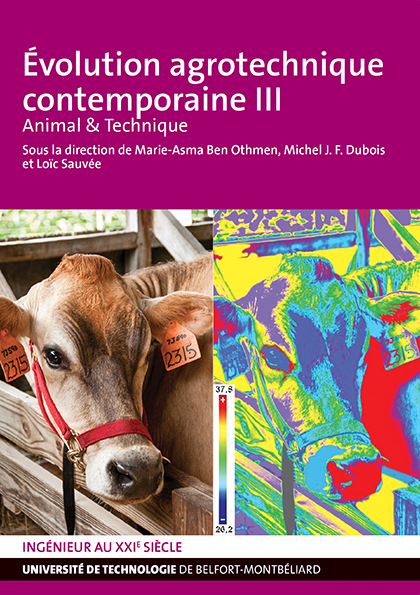
Edited by Marie-Asma Ben Othmen, Michel J.F. Dubois, and Loïc Sauvée
Publication Date: December2020
. Dimensions: 14.8x 21 cm / 264 pages
Paperback:15 euros – ISBN 979-10-91901-47-5
PDF:11 euros – ISBN 979-10-91901-48-2
Bundle (paperback + PDF): 17euros – ISBN 979-10-91901-49-9
Content:Livestock farms and the animal product supply chains are bearing the brunt of the digital revolution. At the same time, we are witnessing growing societal demands for the assessment of animal welfare, a decline in the consumption of animal products, and the emergence of a refusal to consume animal products. Drawing on professional accounts from livestock farmers and developers of digital solutions, as well as presentations by researchers in animal science, anthropology, and the social sciences, this book aims to make sense of these evolving and often conflicting trends and to understand the issues at stake. It shows that animals—whose status is often ambiguous—complicate our relationship with technology due to the profound diversity of both their functions (real and symbolic) and their uses: as production aids, temporal and cultural markers, soil conditioners, and sources of food, textiles, leather, materials, and energy. They occupy a central place in the structure of agricultural systems. Animals are thus integrated into agricultural production through a threefold co-constitutive relationship and within a relational triad of human/animal/technology. It is the links and relationships between these three components—their intensity and the ways in which they are exercised—that drive evolution. The scale of livestock operations and the way in which innovative technical entities incorporate this choice lead to combinations of scales—from the microtechnical level to macrotechnical networks—within which technical evolutions related to animals play out: the singularization of livestock operations on a “human” scale, the standardization of technical systems, certain technical operations, and technical networks within communities of practice among livestock producers. The diversity reflected in the case studies presented in this book allows us to grasp the socioeconomic dimension and its sociotechnical dynamics, the ecological dimension through the animal’s role in agroecological processes, and the technological dimension that fosters open innovation. Ultimately, we can expect that these new possibilities for the joint constitution of the technical/animal/human triad will lead to a radical transformation of the roles that animals will play in the agriculture and food systems of tomorrow.
Contributors: Marie-Asma Ben Othmen, Philippe Barthès, Daniel Cluzeau Éline Dubarral, Michel J. F. Dubois, Julie Dewez, Fatma Fourati-Jamoussi, Michaël Gandecki, Jean Gabriel Levon, Séverine Lagneaux, Loïc Sauvée, Guillaume Schlur, Jacques Servière, Michel Welter
A Frigidaire, and we'll be happy!

Aurélie Brayet
Publication Date: December2019
; Dimensions: 14.8x 21 cm / 240 pages
Print edition:15 euros – ISBN 979-10-91901-34-5
Digital edition:11 euros – ISBN 979-10-91901-35-2
Bundle (print & digital editions): 17euros – ISBN 979-10-91901-36-9
Content:We all remember that famous chorus from Boris Vian’s “Complainte du Progrès.” An object of desire and an iconic symbol of consumer society, the refrigerator is now an indispensable household appliance. While today over 98% of French households own a refrigerator, only 7.65% of French people owned one in 1956. In just over half a century, this “good old fridge” has taken over our kitchens. This “fridge”—which we no longer even notice, yet was the focus of manufacturers’ attention and the object of desire for millions of men and women in the 1950s—was, however, conceived by some of the biggest names in design. This invisible yet indispensable appliance is also a symbol of our society: the heart of the consumer society, both a factor in and a symptom of the environmental crisis, and a work of art in a museum…
A complex technical, cultural, and social object deeply shaped by the spirit of the domestic arts, the refrigerator stands out among the other objects that fill our kitchens. The technical, social, and cultural history of the refrigerator spans the ages, recounting the stories of families, nations, and ultimately “grand history,” It is also the chronicle of a great adventure—or even a “war”—in science and technology: the19th-centuryquest by researchers to find solutions for improving refrigeration before making it accessible to all in the20thcentury.
Contemporary Agrotechnological Developments II
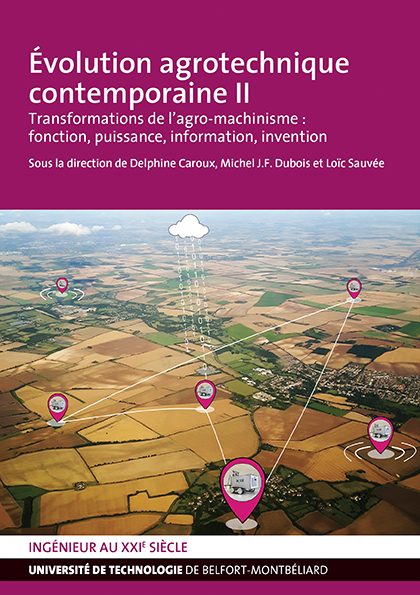
Edited by Delphine Caroux, Michel J.F. Dubois, and Loïc Sauvée
Publication Date: May2018
; Dimensions: 14.8x 21 cm / 200 pages
Print edition:15 euros – ISBN 979-10-91901-30-7
Digital edition:11 euros – ISBN 979-10-91901-31-4
Bundle (print & digital editions): 17euros – ISBN 979-10-91901-32-1
Content:Contemporary agriculture is undergoing a major technological transformation, and at the same time, agricultural machinery is undergoing a profound transformation. Drawing on the professional accounts of farmers and agricultural equipment entrepreneurs, as well as on presentations by researchers in the social sciences and agricultural sciences, this book aims to understand these developments and grasp their dynamics.
Indeed, agricultural equipment serves as a major vehicle for integrating the multifunctionalities of agro-ecosystems made possible by the living world—both plant and animal. New technologies can enhance and intensify these effects. But agricultural machinery, through its flexibility and adaptability to various functions combined at different scales—from the field to virtual spaces, including the farm itself—fits into a multitude of new configurations, involving connected devices, energy autonomy in agricultural production systems, adaptations of existing tools, and the invention of new tools…
At the heart of these transformations, some farmers are committed to transforming production methods by developing a comprehensive farm management plan and are contributing to these changes by expanding their capacity for technical and/or agromachinery-related invention and innovation. This renewed capacity for invention most often arises in connection with new associated environments. The ongoing evolution of agricultural machinery could thus foreshadow a radical shift in the ways agricultural knowledge and techniques are created and disseminated.
Contributors: Matthieu Arnoux, Marie-Asma Ben Othmen, Delphine Caroux, Petros Chatzimpiros, Corentin Cheron, Philippe Colin, Xavier David-Beaulieu, Arnaud De La Fouchardiere, Michel J.-F. Dubois, Fatma Fourati-Jamoussi, Michel Galmel, Perrine Herve-Gruyer, Romain Piovan, Loïc Sauvée.
The Origins of Innovation
Edited by Marianne Chouteau, Joëlle Forest, and Céline Nguyen
Publication Date: March2018
. Dimensions: 14.8x 21 cm / 200 pages
Print edition:14 euros – ISBN 979-10-91901-27-7
Digital edition:9.80 euros – ISBN 979-10-91901-28-4
Bundle (print & digital editions): 16euros – ISBN 979-10-91901-29-1
Content:Innovation is undoubtedly one of the key terms of recent years. As a driver of growth and a source of hope, it continues to attract the interest of businesses, organizations, and local governments. The contributions gathered in this volume thus aim to shed light on the “mode of existence of innovations,” to borrow the phrase from the philosopher Gilbert Simondon, whose fruitful thought helps us reflect on technology and integrate it into culture.
This book therefore seeks to deepen our understanding of the innovation process by posing the following questions: What is the role of the innovator? To what extent does the social, cultural, political, and other environments influence the genesis of innovation? Can we identify the application of creative rationality during the design process?
To answer these questions, we offer readers a historical and original approach: that of biographies, which, by their very nature, incorporate the context of action. We posit that the biography of innovation serves as a means of understanding how innovations come about. The seven chapters of this book provide valuable insights that shed light on the individuals involved in the innovation process while also highlighting the conditions under which these innovations can emerge. The biographies of innovations at the heart of this book will take us on a journey through time (from the 15th century to the present) and across a variety of technical and scientific fields: from everyday ceramics to hydraulic rivets, including printing, watchmaking, and the automotive industry, all the way to chemistry and scientific instrumentation.
Contributors: Marianne Chouteau, Jérôme Fatet, Joëlle Forest, Bruno Jacomy, Philippe Jaussaud, Pierre Lamard, Alain P. Michel, Martine Mille, Céline Nguyen.
Creation, Creativity, and Innovation in Engineering Education and Practice
Edited by Michel J.F. Dubois, Marie-Laure Vitali, and Michel Sonntag
Publication Date: December2017
. Dimensions: 14.8x 21 cm / 288 pages
Print edition:17 euros – ISBN 979-10-91901-24-6
Digital edition:12 euros – ISBN 979-10-91901-25-3
Bundle (print & digital editions): 19euros – ISBN 979-10-91901-26-0
Content:We are witnessing a shift in how the skills required of tomorrow’s engineers are defined—those who are expected to bring about a societal transformation deemed urgent. There is a strong call for engineers to maintain their rigor and methodical approach while also being capable of conducting research, inventing new processes, new tools, and new finished products, and innovating—that is, being able to see inventions through to their integration into society.
The 21st-century engineer, while mastering computer science, mathematics, and the sciences relevant to their field, will not be content to merely be a modeler and optimizer. They will be able to take into account systemic challenges such as sustainability and social viability in their role as a designer and driver of innovation. Their ingenuity will not be limited to producing high-performance systems and products; they will dare to engage in dialogue with artists and take into account the societal implications of innovation. They will therefore have developed an aesthetic sensibility and will be able to transform themselves into “architects,” open to anthropology and sociology as well. In the context of sustainable development, ethics will not remain a dead letter. In his own way, he will thus become part of the new model of humanism that is emerging.
This is what emerges from this book, where the diversity of perspectives is enlightening and formative. Schools open to creativity and networks of innovative companies—through the interactions between people and disciplines that they foster—can serve as the catalyst for such a model. The integration of creativity into engineering education and practice, testimonials about what is being achieved, and the implementation of project-based learning broaden the range of possibilities and encourage those who dare to take risks.
Contributors: Nejib Abdelmoula, Maxime Agnès, Nicolas Bataille, Edwige Bombaron, Samira Bourgeois-Bougrine, Emmanuel Cardonna, Gérard Chamayou, Marie-Françoise Chevallier-Le Guyader, Marianne Chouteau, Laurent Couturier, Mathieu Dalmais, Auréline Doreau, Michel Dubois, Marie-Pierre Escudié, Joëlle Forest, Fatma Fourati-Jamoussi, Alain Fruleux, Linda Gardelle, Nathalie Gartiser, Benoît Humblot, Sandra Huret, Aurélie Javelle, Gaëlle Kotbi, Souad Latorre, Gilles Lecocq, Valérie Leroux, Tiphaine Liu, Laurent Mahieu, Sophie Mano-Avril, Arnaud De Maria, Denis Maricourt, Tanguy Martin, Céline Nguyen, Jean-Gabriel Offroy, Eduardo Palmieri, Olivier Reynet, Anaïs Rolez, Julien Romestant, Camille Rouchi, Ana Ruiz Bowen, Loïc Sauvée, Michel Sonntag, Marie-Laure Vitali.
Contemporary Advances in Agricultural Technology
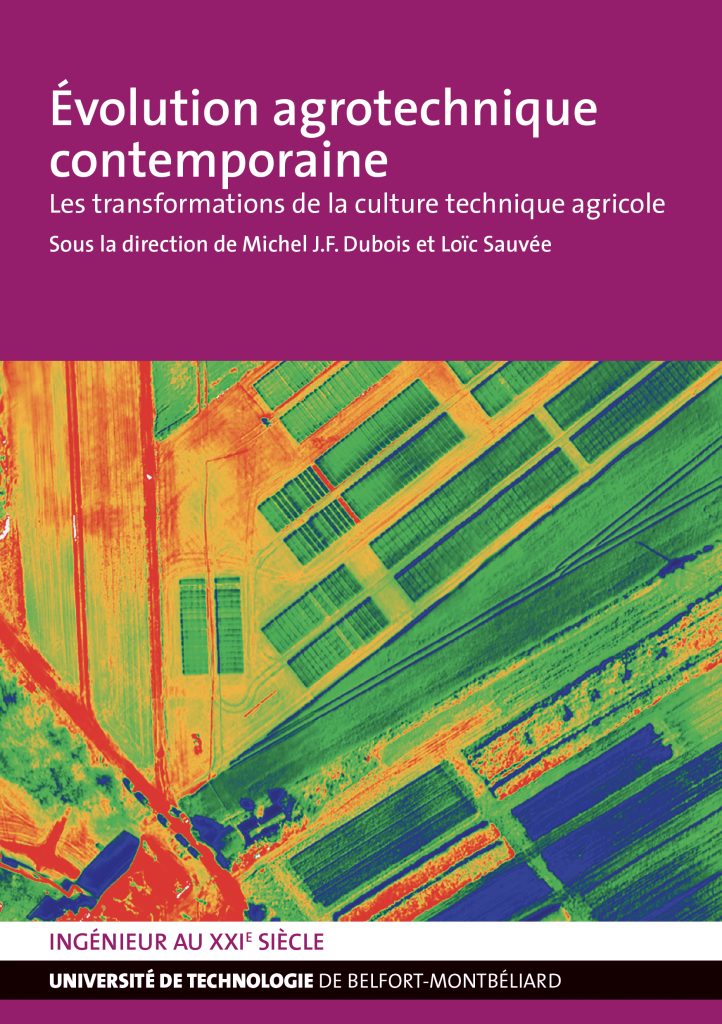
Edited by Michel J.F. Dubois and Loïc Sauvée
Publication Date: April2016
; Dimensions: 14.8x 21 cm / 240 pages
Print edition:15 euros – ISBN 979-10-91901-15-4
Digital edition:11 euros – ISBN 979-10-91901-16-1
Bundle (print & digital editions): 17euros – ISBN 979-10-91901-17-8
Content:Recent technical developments in the agricultural sector are shaped by complex trends: the digital revolution, the rediscovery of so-called natural processes, the simplification of techniques, and the search for synergies linked to the need for energy independence.
How should we interpret these seemingly contradictory trends? In this book, we have chosen to foster a dialogue between farmers and researchers in the humanities and social sciences in order to understand the new relationships that exist between humans, technology, and living organisms.
To examine these agrotechnological developments, we began by examining technology itself and its history; we then hypothesized that these developments take a multitude of possible paths in the processes of living production and in their manifestation at different levels of interaction.
Our collective exploration focused on the foundations of life and technology, as well as the representations associated with them. It continued with the (re)discovery of these interactions. The book shows that this opening up of possibilities—made visible by the convergence of different perspectives—could lead to the invention of a new agricultural technical culture. Ultimately, it is the farmer’s situation, his autonomy, and his place and role in the transformations to come that constitute the central focus of this book.
Contributors: Michel J.-F. Dubois, Alfred Gässler, Michel Griffon, Xavier Guchet, Patrick du Jardin, Fabien Knittel, Erick Lebrun, Aubin Lafon, Michel Lucas, Thierry Ribeiro, Loïc Sauvée
Humanities, Economics, and Social Sciences (HESS) for Engineers?
Edited by Nathalie Gartiser and Jacques Audran
Publication Date: April2016
. Dimensions: 14.8x 21 cm / 272 pages
Print edition:15 euros – ISBN 979-10-91901-09-3
Digital edition:11 euros – ISBN 979-10-91901-10-9
Bundle (print & digital editions): 17euros – ISBN 979-10-91901-11-6
Content:The various dimensions of a constantly changing world—in which young engineers operate—require them to understand and master its complexity. Indeed, 21st-century engineers rarely work alone, and the challenges they face extend beyond the local context. The effectiveness of their work is determined by interaction and dialogue with others, whether within established teams or those yet to be formed. Companies operate as networks, as interdependent systems. This requires knowledge and skills that extend beyond the strictly technical realm. This is where courses in the humanities, economics, and social sciences (HESS) at engineering schools play an important role.
This collective work aims to explain, through short articles on various HSE topics, how these engineers are prepared through such courses. It presents real-world examples that demonstrate the need to learn in order to understand the environment in which engineers operate and contribute. It also shows that without knowledge of social sciences, humanities, and engineering studies (SHES), one may sometimes be unable to act or achieve results—or, at the very least, fail to equip oneself with the means to do what one wants to do or what one has decided to do. For the sake of clarity, this book draws on concrete illustrations and case studies. It also presents the theoretical fields to which the articles refer, as well as the scientific questions and perspectives that arise today.
This book was produced as part of the Réseau Ingenium association, which brings together faculty members, faculty-researchers, and schools concerned with the issue of teaching and research in the humanities, economics, and social sciences at engineering schools. It serves as a synthesis of the work of its Ingenium Est branch, whose members meet regularly to discuss issues related to education in the humanities, economics, and social sciences at engineering schools in eastern France.
Contributors: Jacques Audran, Raphaël Bary, Caline Christine, Marianna Epicoco, Sara Fernandez, Isabelle Fornasieri, Nathalie Gratiner, Christian Girardet, Patricia Houdebert, Vera Ivanaj, Tiphaine Liu, David Oget, Corinne Petit, Jean Renaud, Nathalie Rodet-Kroichvili, Sarah Sands-Meyer, Christophe Schmitt, Michel Sontag, Martine Tani, Marie Tsonga Tabi, Bernard Vitaux, Jacques Woda
Ingédoc 2012
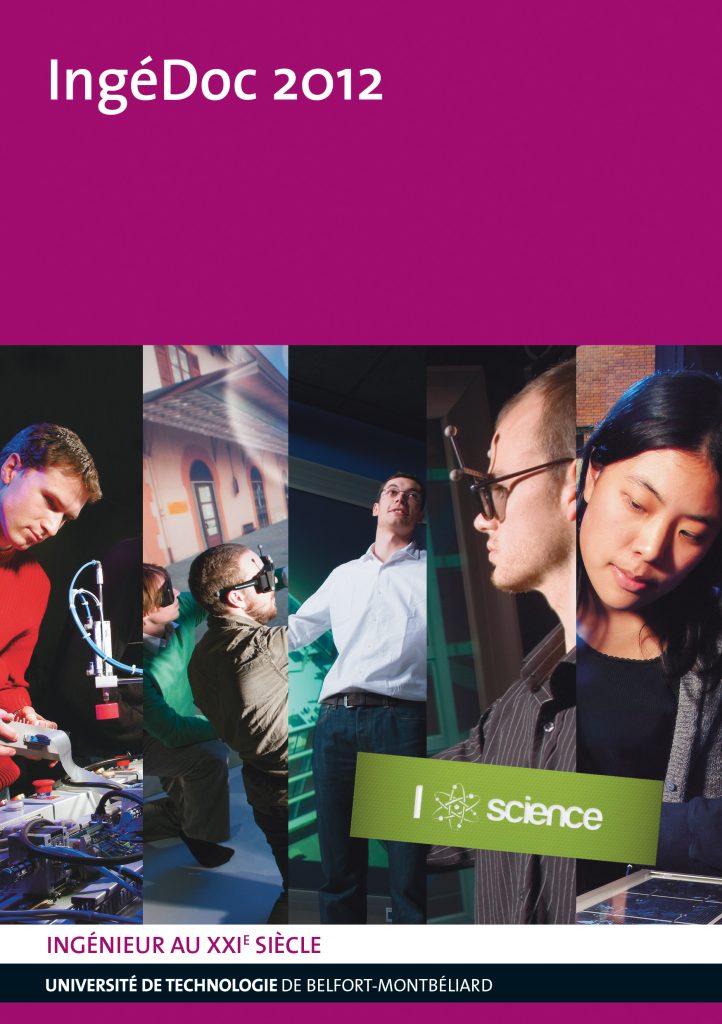
Publication date:December 2013
. Dimensions: 14.8x 21 cm / 246 pages
Print edition:18 euros – ISBN 978-2-914279-83-3
Digital edition:12.60 euros – ISBN 978-2-914279-84-0
Bundle (print & digital editions): 20euros – ISBN 978-2-914279-85-7
Audience: researchers, professionals, students
Content:Organized entirely by the Association of Doctoral Students and PhD Graduates at the University of Technology of Belfort-Montbéliard (DOCEO-UTBM), the IngéDoc Days are designed to showcase the research being conducted in UTBM’s laboratories.
This volume brings together the best papers presented at the 2012 IngéDoc conference. They were selected by a scientific committee and are organized into five sections:
All of them demonstrate the richness and diversity of doctoral students’ contributions to research at UTBM.
Contributors:ABBAS-TURKI Abdeljalil, AL KHATIB Ahmad*, ALLIMANT Alain, ANH-TUAN Ta*, AUBIGNAT Émilie*, BAALA Oumaya, BAKHOUYA Mohamed, BAZZARO Florence, BEDA Tibi, BENNES Lionel*, BERTRAND Pierre, BILLARD Alain, BILLIÈRES Dominique, BLUNTZER Jean-Bernard, BOLOT Rodolphe, BOUQUAIN David, BOURIOT Béatrice, CAMINADA Alexandre, CHARIETE Abderrahim*, COLLE Aurélien*, DELONCA Mélanie*, DENG Sihao, DJERDIR Abdesslem, DURAMOU Yann*, El MOUDNI Abdellah, FRANÇOIS Peyraut, GABER Jaafar, GAILLARD Arnaud, GRUBER Maxime*, GUI Yunfang*, Damien GUILBERT*, Rabie HABIB, Frédéric HOLWECK, Homam ISSA*, Nadia LABED, Cécile LANGLADE, Frédéric LAPOSTOLLE, Nadhir LEBAAL, Weidong LEI*, Michel LENCZNER, Hanlin LIAO, Taikai LIU*, MAGLIONI Cesare, MAHDJOUB Morad, MANIER Hervé, MANIER Marie-Ange, MEDETOV Seytkamal*, MOHAMMADI Ali*, MONTAVON Ghislain, N’DIAYE Abdoul, NGUESSONG NKENFACK Alain*, OSTROSI Egon, PERRONNET Florent*, PEYRAUT François, PLANCHE Marie-Pierre, ROTH Sébastien, SAGOT Jean-Claude, SEICHEPINE Jean-Louis, SELEZNEFF Serge, STORA Thierry, SUO Xinkun*, TABIA Nourredine, TCHOUMI Thierry*, THIONNET Alain, VAUTHERIN Béatrice*, WACK Maxime.
* Ph.D. student
Social Inclusion, Equality, and Diversity
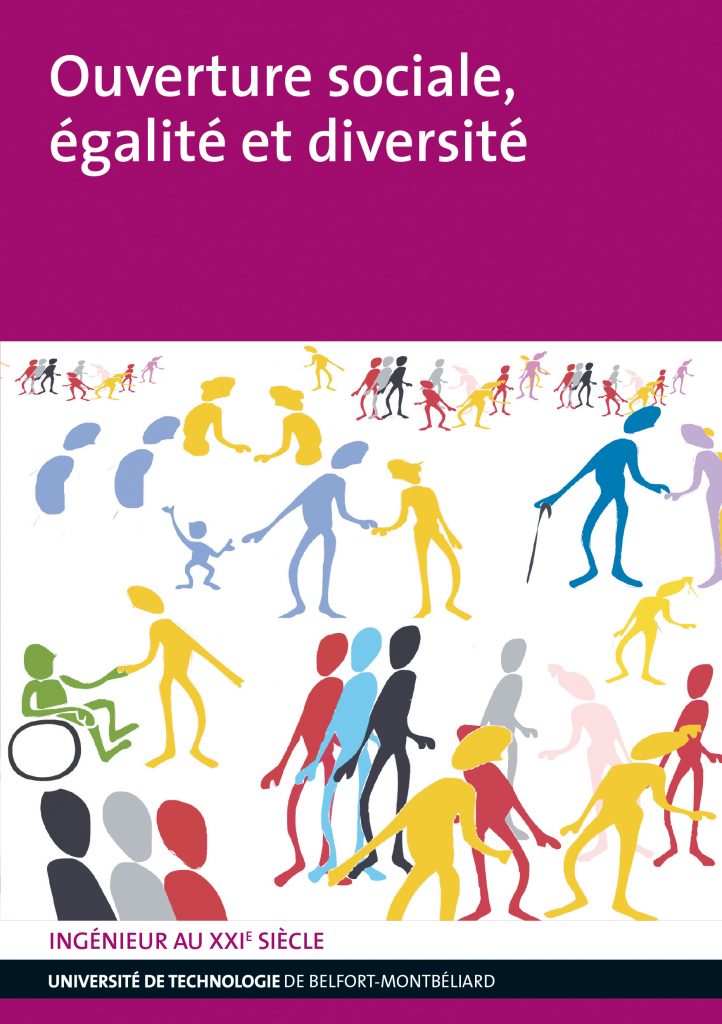
Edited by Maxime Wack, Ahmed Nait-Sidi-Moh, Jaafar Gaber, Pierre-Yves Gilliéron, and Yves Alexandre
Publication Date:June 2013
. Dimensions: 14.8x 21 cm / 192 pages
Print edition:12 euros – ISBN 978-2-914279-77-2
Digital edition:9 euros – ISBN 978-2-914279-78-9
Bundle (print & digital editions): 14euros – ISBN 978-2-914279-79-6
Audience: specialistsin the sociology of education and organizational management, teachers, students
Contents:This volume brings together in-depth, theory-based analyses and practical, real-world accounts. All are drawn from the discussions that arose during the conference held at the Belfort-Montbéliard University of Technology in December 2011 on the topic of equal opportunity in higher education. The speakers, who came from a wide variety of backgrounds, agreed to transform their oral presentations into written texts. This effort to rewrite their presentations in accordance with academic standards lends even greater weight to their commitment and value to their reflections.
Authors: Kévin André, Anne-Sophie Berche, Jean-Marie Boizeau, Farid Bousbaine, Maria Giuseppina Bruna, Aleth Chevalley, Marie-Christine Creton, Chantal Dardelet, Geoffrey Fallet-Fidry, Arbia Guezgouz, Frédéric Jonnet, General Philippe Levé, Samantha Nea, Christian Queney, Aurélie Stauffer
Having organized industrial conferences in Belfort for more than 20 years, the Student Association of the Belfort-Montbéliard University of Technology decided in 2005 to extend the impact of these conferences each year by publishing the key papers.
Engineer: A User's Guide
Various Authors (2010 Industrial Congress)
Published:March 2012
. Dimensions: 14.8x 21 cm / 64 pages
Paperback:Out of print – ISBN 978-2-914279-59-8
PDF:5 euros – ISBN 978-2-914279-60-4
Audience:Students, teachers, technicians, and practicing engineers
Contents:This book compiles selected presentations given at the26thIndustrial Congress organized by students at the University of Technology of Belfort-Montbéliard.
The participants’ goal was to gain a better understanding of the engineering profession. It became clear that, while engineers certainly differ in the tasks they perform or the decisions they make, they all share the common challenge of solving problems in a constantly changing environment. It is therefore up to engineers to adapt quickly and manage a wide range of technical and managerial tasks that require them to interact with other stakeholders within the company.
Authors: Claude Barthoulot, Adeline Brancourt, Liyliy Cheang, Adrien Gigon, ThierryHartmann, SergeReverchon, Jacques Woda
Engineering and Communication
Various Authors (2009 Industrial Congress)
Publication Date:July 2010
. Dimensions: 14.8x 21 cm / 144 pages
Paperback:13 euros – ISBN 978-2-914279-48-2
Audience:Students, teachers, technicians, and practicing engineers
Content:Historically associated with design and production, the engineering profession increasingly involves communication—both quantitative and qualitative—due to the expansion of business activities and the need to manage information. There are many reasons for this: new tools and networks, the growing complexity of the economy, an increase in procedures, and the heightened importance of interpersonal and relational aspects. This applies equally to industry—whether small or massive—healthcare, and finance, encompassing both day-to-day operations and disaster situations. It is also important—as much as possible—to control the flow of information in relation to industrial espionage (a long-standing and ever-evolving problem) or the proliferation inherent in the internet.
Authors: Jean-Louis Boulet, Dominique Fonvieille, Michel Fourcade, Valentine Fourcade, Bruno Grossin, Matthieu Haratyk, Franck Jullien, Jean-Pierre Lartigue, Véranith Ly, Noël Zagala
Engineers at the Heart of Innovation
Various Authors (2008 Industrial Congress)
Publication Date:September 2009
; Dimensions: 14.8x 21 cm / 126 pages
Paperback:13 euros – ISBN 978-2-914279-42-0
Audience:Students; practicing technicians or engineers; members of the general public with an interest in the subject.
Content:Innovation, a catch-all term, is presented here in detail through several significant examples: new materials, nuclear fusion, renewable energy, the role of virtual technology in vehicle design, the relationship between marketing and technical innovation, the role of patents, and more.
These issues are addressed from two perspectives:
Conducted in a straightforward manner by experts and professionals, these analyses are intended for students, practicing technicians and engineers, and the general public with an interest in the subject.
Authors: Frédéric Achard (PSA Peugeot-Citroën), Daniel Berthod (Unilever), Jean-Louis Chaumel (University of Quebec at Rimouski, Canada), Pascal Corbel (University of Versailles Saint-Quentin), Jean-Luc Duchateau (CEA), Xavier Greffoz (Sogeti), Olivier Juglair (Unilever), Michelle Salvia (École Centrale de Lyon), Thierry Voillequin (PSA Peugeot-Citroën)
The Engineer in His or Her Environment
Various Authors (2006 Industrial Congress)
Publication date:July 2007
. Dimensions: 14.8x 21 cm / 182 pages
Paperback:13 euros – ISBN 978-2-914279-35-2
Audience:Engineering students, technicians, and practicing engineers
Content:How much importance should engineers place on their environment?
While this question was rarely asked in the past, it has now become a pressing issue, both within companies and in relation to nature.
Respect for the environment? The main topics discussed here include: contemporary climate change, the legal aspects of environmental action, and examples of new practices in eco-design and management.
If business is meant to serve people, how do things play out in the context of offshoring? The book discusses government tools, ethics, corporate social responsibility, and the management of the blue-collar workforce in the age of just-in-time production.
This book offers in-depth analyses and current examples from industry.
Authors:Jean-Marie Binétruy, Patrick Gilormini, François Goulard, Dominique Landbeck, Patrice Lucas, René Mathieu, Marie-Antoinette Mélières, François Nicol, Laurent Noca
Innovation and Management

Various Authors (2005 Industrial Congress)
Publication Date:September 2006
. Dimensions: 14.8x 21 cm / 140 pages
Paperback:Out of print, available online for free – ISBN 978-2-914279-27-7
Audience:Engineering students and practicing engineers
Content:By considering innovation and management together, we can better understand how the engineering profession is currently evolving.
Today, engineers no longer limit their scope of work to the technical field alone; they are often called upon to apply their expertise in activities with a strong intangible component (product design, service organization) and interpersonal aspects. How do these activities change expectations for future engineers?
Innovation represents an ongoing challenge for many companies, which must mobilize and generate resources, methods, and knowledge, and learn to manage them. Furthermore, in a globalized, complex, and unpredictable world, the management of activities, people, or teams takes on a whole new dimension.
An engineer’s skills are applied both to the products themselves and to the activities that produce them. Here you will find several in-depth articles on these topics.
Authors: Jean-Christophe Almira, Rached Benbdallah, Denis Choulier, Roni Horowitz, Pascal Jarry, Fabienne Picard, Henry Roux de Bézieux, Pierre-Alain Weité