Home / Research and Innovation / Research Centers and Laboratories
UTBM trains engineers who are quickly ready for the workforce and particularly adaptable to technological advancements and societal changes. Its programs are grounded in research and commercialization.
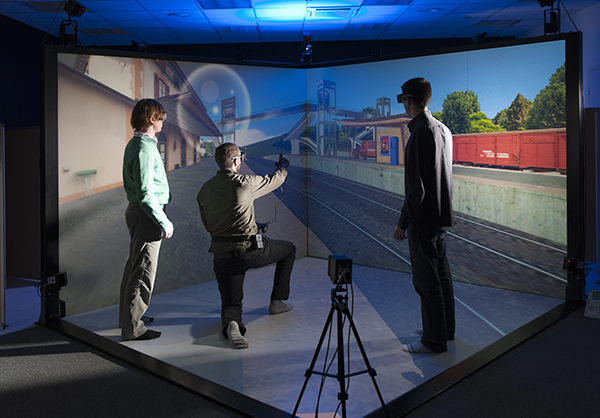
Research at UTBM is conducted in three CNRS joint research units (FEMTO-ST-UMR6174, IRAMAT-UMR7065, and ICB-UMR6303), a research federation (FC LAB-FR3539) dedicated to fuel cell technology, as well as three laboratories and research teams.
Several key partnerships with research organizations round out the picture, notably a CEA-affiliated research laboratory (LRC2635) in the field of high-performance surface engineering and a joint laboratory between the UT Group and Shanghai University, ComplexCity, whose goal is to develop technological, organizational, and social innovations to improve urban living.
Finally, research at UTBM is distinguished by its partnership activities supported by major companies such as ALSTOM, GE, Peugeot, EADS, and Safran…
114 faculty researchers and 110 doctoral students form the backbone of the research program, which had a 2016 budget of 16 M€, including 5 M€ from contract research conducted in direct partnership with industry.
FEMTO ST
Franche-Comté Electronics, Mechanics, Thermal Engineering, and Optics – Science and Technology
The FEMTO-ST Institute (Franche-Comté Electronics, Mechanics, Thermal Science, and Optics – Sciences and Technologies, UMR 6174) is ajoint research unit established on January 1, 2004, through the merger of five laboratories in Franche-Comté, which formed its initial departments.
It operates under the joint supervision ofthe University of Franche-Comté(UFC), theNational Center for Scientific Research(CNRS),the National School of Mechanics and Microtechnology(ENSMM), andthe Belfort-Montbéliard University of Technology(UTBM).
Several teams from UTBM have joined the Femto Institute since January1, 2017. Among them are:
IRAMAT
Archaeomaterials Research Institute
IRAMAT (UMR 7065) is an interdisciplinary institute that brings together the complementary expertise of three laboratories located in Belfort (Laboratory of Metallurgy and Cultures), Orléans (Ernest-Babelon Center), and Paris-Saclay (Laboratory of Archaeomaterials and Weathering Prediction). IRAMAT operates under the supervision of the CNRS, the University of Orléans, Paris-Saclay University, UTBM, and the Ministry of Culture, and is supported by INRAP and the CEA. It draws on the expertise of archaeologists, historians, physicists, mechanical engineers, and chemists, developing characterization and dating techniques applied to ancient materials and cultural heritage objects to address archaeological and historical questions.
The research is organized around the following four areas:
ICB
Carnot Interdisciplinary Laboratory of Burgundy
The ICB laboratory is made up of approximately 300 researchers who are developing new capabilities in optics and new materials for applications in industry, medicine, and telecommunications.
The UTBM teamsfocus their activities on the processes involved in the development of structural materials (additive manufacturing) and thermal spray coatings, with the aim of improving their properties and achieving new performance levels, as well as on mechanical design and optimization.
FC Lab
Fuel Cell Lab
The FC Lab Research Federation brings together all the laboratories in Franche-Comté working on fuel cell systems (FCS)
ERCOS / ELLIADD
Ergonomics and Systems Design / Publishing, Languages, Literature, Computer Science, Arts, Teaching Methods, Discourse
Combining the humanities and social sciences, life sciences, and engineering sciences, theERCOS/ELLIADD team(E.A. No. 4661) conducts research on innovative product design, focusing in particular on the value of the product for humanity.
CIAD
Distributed Knowledge and Artificial Intelligence
The CIAD laboratory is a research laboratory under the supervision of the UBFC, the University of Burgundy, and the UTBM. CIAD’s research focuses on the fields of artificial intelligence—specifically distributed artificial intelligence, machine learning, knowledge representation, environmental perception, and optimization using bio-inspired approaches.
The main themes of CIAD are:
NIT
Nanomedicine, Imaging, Therapeutics
The Nanomedicine, Imaging, and Therapeutics (NIT) Laboratory is a multidisciplinary research laboratory under the supervision of the University of Franche-Comté and UTBM, composed of physicists, chemists, computer scientists, automation engineers, physicians, and pharmacists who have come together to develop new diagnostic tools and therapies using nanotechnology, as well as new organizational models for healthcare systems.
The “Health Systems Organization” (O2S) team at the NIT laboratoryisorganized around two main areas of focus: