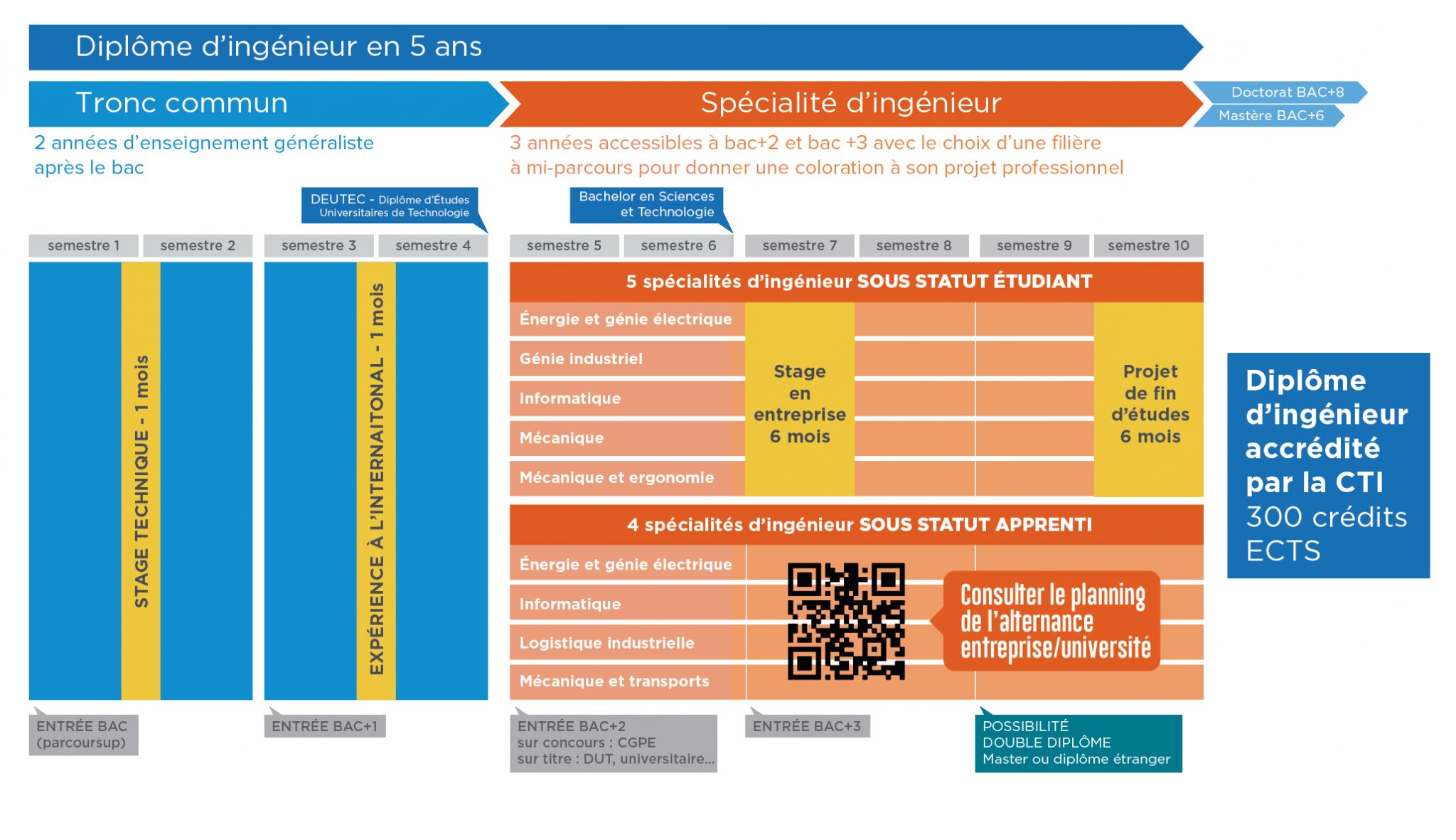
This diagram outlines the structure of the program at UTBM leading to an engineering degree accredited by the CTI (Commission des Titres d'Ingénieur), equivalent to 300 ECTS credits. The program is divided into two main phases: the core curriculum (2 years) and the engineering specialization (3 years).The program spans 10 semesters (5 years total) following the baccalaureate:Years 1 and 2 (Semesters 1–4): Core curriculum (general education).Years 3, 4, and 5 (Semesters 5–10): Engineering specialization.After graduation: Students may continue on to a Master’s degree (BAC+6) or a Doctorate (BAC+8).The Core Curriculum (Semesters 1 through 4)This period corresponds to 2 years of general education following the baccalaureate. It is marked by two major experiences:Between Semester 1 and Semester 2 (Upon Entering After the Baccalaureate): A one-month technical internship.Between Semester 3 and Semester 4 (Admission after one year of post-high school study): A one-month international experience.Intermediate Degree: At the end of Semester 4, students can earn the DEUTEC (Diplôme d’Études Universitaires de Technologie).
The Engineering Specialization (Semesters 5 through 10)
These three years are open to students with a BAC+2 degree (via the CGPE entrance exam, a DUT, or a university degree) and to those with a BAC+3 degree.
Midway through the program, students choose a track to shape their career path. An intermediate degree, the “Bachelor of Science and Technology,” is also awarded at the end of semesters 5 and 6.Students can choose between twostudent statuses to pursue their specialization:
The 5 engineering specializations under the “STUDENT” status:
Energy and Electrical Engineering - Industrial Engineering - Computer Science - Mechanical Engineering - Mechanical Engineering and Ergonomics
The 4 engineering specializations under the “APPRENTICE” status:
Energy and Electrical Engineering - Computer Science - Industrial Logistics - Mechanical Engineering and Transportation
Internships and projects for students: Semester 7:
A 6-month internship at a company.
Semester 10: The 6-month capstone project (PFE). B. Visual Note: For apprentices, a QR code links to the work-study schedule. 4. Transfer Pathways and Graduation Opportunities
Parallel Entry Points: It is possible to join the program directly at any stage: at the BAC+1 level, at the BAC+2 level (through competitive entrance exams or based on academic qualifications), or at the BAC+3 level.
Dual Degree: Starting in the 8th semester, students have the option to pursue a dual degree (Master’s or foreign degree). Your paragraph here