
Table of Contents

Mechanical Engineering Major

This program enables students to learn design methodologies using a new mechanical and digital engineering platform. Students can develop their knowledge and skills through product engineering projects carried out in collaboration with industry, research laboratories, and various institutional partners.

Training

Mechanical Design: From Innovative Concept to Product Prototype

The main strength of the Mechanical Engineering and Design program lies in its project-based, industry-focused teaching approach.

Once again this year, the completed projects were showcased through several posters, visual renderings, prototypes, and presentation videos, which are now available on the UTBM YouTube channel.

Some projects specifically involve multiple vehicles in the fields of automotive, marine, aeronautical, and aerospace transportation; some of these, developed in close collaboration with the Energy Department and the Espera SBARRO School, participated in the Monte Carlo New Energy Rally. In 2013–2014, GMC students won several awards at various national and international competitions: the Airbus Group Prize at the Student Aerospace Challenge,third prizeat the international edition of the 24 Hours of Innovation, and the Innovation Prize at the ArcelorMittal Challenge, demonstrating the excellent scientific and technical quality of the education provided.

Logo for a state-accredited engineering degree

Practical Information

Your Responsibilities

  • Designing and sizing a product with primarily mechanical, thermomechanical, mechatronic, or even cyber-physical characteristics: from needs analysis to the creation of functional prototypes
  • Use modeling, simulation, and numerical optimization techniques to understand and predict the full range of stresses and multiphysical behaviors of the complex mechanical systems under study (architecture, structures, fluids, thermal behavior, vibrations, etc.)

Target Occupations

Product Architect, Design Engineer, Calculation Engineer, Project Manager, Business Development Engineer, Test Engineer

Product Design and Development (PDD)

Engineers graduating from the CDP program are trained to translate market needs into specifications, then into product concepts, and finally into prototypes that incorporate all industrial aspects. Product design requires a comprehensive and methodical approach—known as a systems-based approach—that involves multiple departments within the company. Engineers graduating from this program will be able to transform functional specifications into product concepts, then into prototypes that incorporate all industrial aspects, with the ability to continue their development through to production. As part of projects carried out with industrial companies—at the local, national, or even international level—students will be required to use several advanced computer tools to aid in product design and rapid prototyping (Project Management, CAD, Finite Element Analysis, Technical Data Management, Collaborative Engineering, Knowledge-Based Engineering, 3D scanning, rapid prototyping, etc.).

Materials Science Applied to Technological Projects (SMART)

Materials, manufacturing processes, post-processing, characterization, and related technologies are among the key areas that must be mastered to support technological development. Engineers graduating from the SMART program therefore aim to innovate in product design and development through materials and processes, while integrating societal and environmental considerations. The curriculum offered within the SMART program—which has recently undergone significant updates to incorporate research findings and resources focused on new materials and additive manufacturing processes—enables students to develop the ability to innovate effectively and achieve technical and economic excellence, both of which are essential to the design and development of industrial products and processes, ranging from the evaluation of technological options to their implementation in production.

Mechatronic Systems Design (CSM)

The goal of this CSM program is to train engineers capable of designing and managing complex mechatronic systems—that is, systems that integrate various disciplines and technologies (mechanical engineering, computer science, automation, and electronics). A “mechatronics” engineer is more of an architect and a generalist than a specialist. The curriculum, grounded in the field of mechanics, covers complete systems with expanded functions (control systems, sensors, actuators, microcontrollers, etc.). It includes numerous team-based project assignments in real-world, industry-like scenarios. The training provided within the CSM program also covers some of the most advanced methods and tools for developing mechatronic systems available on the market and used in industry.

Modeling and Optimization of Thermomechanical Systems (MOST)

Trained in the numerical modeling and simulation tools currently used in industry, engineers graduating from the MOST program are able to adapt to a wide variety of situations across all sectors where mechanical engineering is applied. The courses offered in this program are designed to equip engineers with a broad range of skills for their future careers: the ability to analyze and evaluate the validity of simulation and test results, enabling them to lead collaborative projects in a wide range of application areas, including mechanical structures subjected to linear and nonlinear multiphysics stresses, engines and other propulsion systems, centralized power generation systems, renewable energy, and the development of industrial computational codes, among others.
Business Technology Platforms

  • Experimental Mechanics: Polariscope, Tensile Testing Machines, Compression Testing Machines, Bending Testing Machines, Torsion Testing Machines, Hardness Testing, Truss Analysis and Modeling
  • Materials: Microscopy and metallurgy equipment, Crystallography and corrosion, Tribometer, Tensile testing machine, Heat treatment furnaces
  • Mechatronics: Servo systems, digital axis control, Festo gripper arms, Robotics (development and programming of Microchip microprocessors, C language, electronic circuit simulation…), Data processing and acquisition systems (National Instruments, LabVIEW), simulation software for modeling and analyzing multi-domain systems (Amesim), multiphysics system modeling software (MATLAB Simulink), and software for modeling and simulating the behavior of dynamic, electrical, mechanical, and hydraulic systems (20SIM)
  • Modeling: Wind Tunnel, Study of Porous Media, Charpy Impact Test
  • Design: Prototyping platform, Digital lathes, 3D printer, Digital milling machines
  • Power Engineering: SIREP Nuclear Power Plant Simulator, Wind Tunnel

PLM Software Platforms

  • CAD (CATIA, Pro)
  • Multiphysics Simulation (COMSOL)
  • Rapid dynamics and crash analysis (RADIOSS, etc.)
  • Fluid Mechanics and Thermal Analysis (FLOWMASTER, FLUENT, etc.)
  • Operation and Management of a Nuclear Power Plant (SIREP)
  • Modeling and Analysis of Multidomain Systems (AMEsim, etc.)
  • Finite Element Analysis (ANSYS, DESIGN MODELER, ABAQUS)
  • Calculations, Analysis, and Design (MECAMASTER)
  • Numerical Calculations (MATLAB)
  • Knowledge Management (KADVISER, KROSSROADS, etc.)
  • OPTIMIZATION (FRONTIER METHOD)
  • Collaborative Platform (ACSP, WINDCHILL, TDC SYSTEM)
  • Material Selection (CES Eco Selector)

Student Track and Apprentice Track

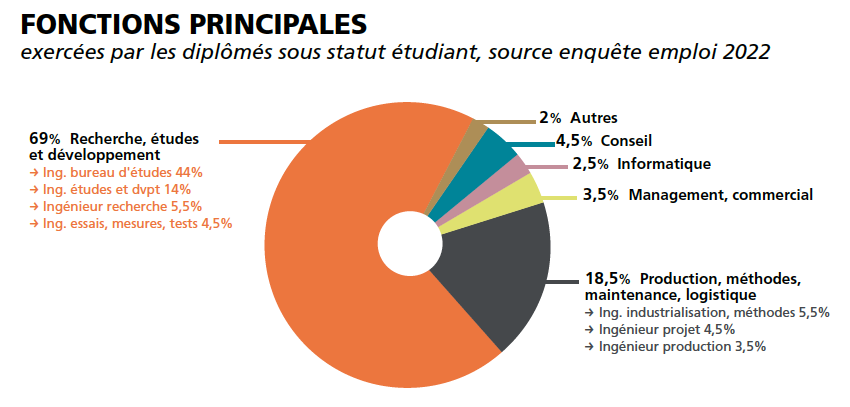
  • Research, Studies, and Development – 69%
  • Production, methods, maintenance, logistics – 18.5%
  • Tip – 4.5%
  • Management, Sales – 3.5%
  • Information Technology – 2.5%
  • Other – 2%

GMC Department YouTube Playlist

RNCP Number 38640
, valid from September 1, 2023, through August 31, 2028

testimonials

Contact