
EDIM Department YouTube Playlist
Home / Training / Engineering Programs / Mechanical Engineering and Ergonomics Specialization
As a key player in the ongoing renewal of product lines—and thus in innovation—mechanical and ergonomics engineers (formerly known as EDIM) take into account the human being in all its dimensions—from muscles and bones to emotions—in their design and evaluation work, while incorporating the fundamentals of ergonomics, design, and sustainable development.
The curriculum, which places a strong emphasis on projects conducted in close collaboration with industry partners and even institutions, is structured around four key relationships essential to creative and innovative mechanical design:
In education, special emphasis is placed on the transition from physical to digital, from virtual to real, and vice versa, thereby making ample room for project-based learning.
Your Responsibilities
Target Occupations
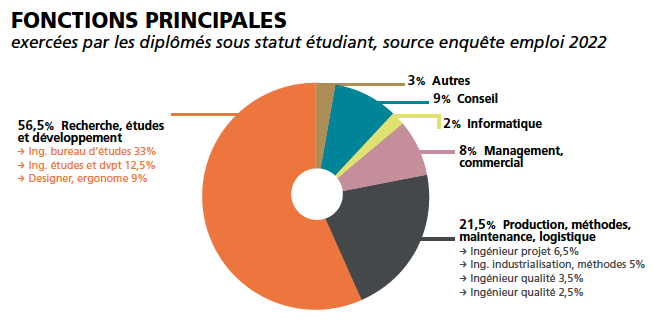
Design Engineer, Design Engineer, Ergonomics Engineer, Manager of Continuous Improvement and Workstation Ergonomics, R&D Specialist, Product Manager, Vehicle or Product Architect, Innovation Manager…
Programs
Industrial Design and Engineering
To collaborate proactively and effectively with the designer to create innovative and desirable products in terms of aesthetics and usability, while ensuring—within a manufacturable specification—that their design is optimized, manufacturing processes are taken into account, and perceived quality requirements are met.
EDIM engineers trained in the DIC specialty are introduced to industrial design through the acquisition of designers’ tools and methods, enabling them to innovate.
Emphasis is placed on plastics processing and composite materials, as well as digital engineering tools (surface CAD, virtual reality with realistic rendering, simulation of plastics manufacturing processes, etc.), which effectively complement the study of mechanical engineering tools.
Ergonomics, Innovation, and Design
To design products that are innovative in their use by applying metrology and ergonomic analysis, digital tools for collaborative engineering, and advanced engineering methods
EDIM engineers trained in the EIC specialization drive innovation by evaluating and designing a product’s usability, while learning to collaborate with ergonomists. Emphasis is placed on digital engineering tools (parametric CAD, digital mannequins, virtual reality, knowledge-based engineering, etc.) to design products tailored to human characteristics, thereby effectively complementing the training in traditional mechanical engineering tools.
Innovation and Eco-Design (inECO)
To apply eco-innovation methods and tools to achieve responsible and “
” design that respects both people and the environment, by incorporating carbon-free energy sources and materials designed to reduce weight.
EDIM engineers specializing in InECO are trained in eco-design and eco-innovation methods and tools. Emphasis is placed on digital engineering tools (CAD, Life Cycle Assessment, etc.), materials for reducing product weight, and clean energy sources to ensure responsible design that respects both people and the environment. Today, eco-innovation serves as a real competitive advantage for mechanical design engineers within companies.
Our Resources
The department is thus equipped with high-performance tools and equipment in the fields of digital technology (CAD, CAM, etc.), rapid prototyping, virtual reality, composites, mechanical testing, and more…
This equipment enables the design, sizing, and optimization of mechanical products and systems, as well as the testing and evaluation of their usability and perceived value, all within a framework of environmental responsibility.
Roles Held by Graduates
Projects
EDIM Department YouTube Playlist
The diploma
Valid from September 1, 2023, through August 31, 2028
I am currently in charge of developing new Business and First Class aircraft seat concepts in R&D at Zodiac. Our clients include the world’s most prestigious airlines, as well as Boeing and Airbus. My projects always start from scratch and proceed all the way to the creation of functional prototypes. These are then presented at various international trade shows, such as the Paris Air Show and AIX in Hamburg. My engineering degree from EDIM, complemented by a Master’s in International Industrial Affairs (A2I), is a significant asset, enabling me to understand and collaborate effectively with professionals in engineering, design, and ergonomics. Additionally, my six-month internship in Peru has given me strong intercultural skills that serve me well in the highly international context of the aerospace industry.
R&D Project Manager at Zodiac Seats France – ZODIAC AEROSPAC