
To become a specialist in the acquisition, processing, and analysis of with applications in the fields of perception for autonomous vehicles, robotics, and medical imaging.
Home / Training / Engineering Programs / Computer Science Specialization
Industrial and service sector companies hire our engineers to manage and develop their information systems, products, and services. Some engineers focus on research and development (39%), while others embark on an international career path starting with their first job (25%). The internships offered cover a very wide range of roles that foreshadow the nature of their first job, as half of them result in a full-time position within the department.
Industrial and service sector companies hire our engineers to manage and develop their information systems, products, and services. Some engineers focus on research and development (39%), while others embark on an international career path starting with their first job (25%). The internships offered cover a very wide range of roles that foreshadow the nature of their first job, as half of them result in a full-time position within the department.

Your Responsibilities
Target Occupations
Network Administrator, Database Administrator, Design Engineer, CIO, Project Manager, Business Engineer, QA Engineer, Research Engineer
The job opportunities available to our engineers span a very wide range of fields, covering all sectors of the secondary and tertiary industries, in both development and research. To meet companies’ ever-increasing need to stand out from their competitors and expand their markets, our program places particular emphasis on international and research experience through specialized tracks.
For first jobs, this type of experience is in high demand among companies, as our surveys on the future of recent graduates show.
Furthermore, because information technology is evolving very rapidly, engineers must be able to continually expand their knowledge and adapt. Another distinctive feature of our program is ourproject-based approach. Carried out in teams and independently, theseprojects allow students to tackle problems for which they must develop their own solutions. Facing the unknown—whether it’s a new programming language or a new algorithm—is an essential exercise for a future engineer, and companies are well aware of this.
The training program also helps participants develop cloud-related skills in partnership with Google Cloud
Contact:utbmgooglecloud@utbm.fr
Programs
Network Infrastructure Design and Deployment
To specialize in the design of wired and wireless infrastructure, and the deployment of local area networks, wide area networks, and radio communication networks such as cellular networks or Internet of Things networks.
Data Science
To design and develop databases, master "business intelligence" tools, and master the techniques and software used for data manipulation—particularly in the field of big data—as well as their processing and analysis.
Software Deployment Methods and Tools
To specialize in the design and deployment of "large-scale" applications while meeting quality and environmental requirements.
Virtual Worlds, UX, UI
To become a specialist in virtual and augmented reality in the fields of entertainment, industrial training, and healthcare, and to design applications that take into account both technological and human factors.
Robotics and Embedded Systems
To specialize in robotics, embedded applications using specific systems, real-time systems, and geolocation systems.
Advanced Computer Programming
To specialize in understanding languages and the development complex and distributed applications, and security through blockchain algorithms.
Artificial Intelligence
To specialize in artificial intelligence techniques: multi-agent systems, optimization, and machine learning.
Network Infrastructure Security and Virtualization
To specialize in system virtualization, security, and system and network administration.
Computer Vision
To become a specialist in the acquisition, processing, and analysis of with applications in the fields of perception for autonomous vehicles, robotics, and medical imaging.
Our Resources
Hardware platforms and specialized software:
In collaboration with the laboratories
Other platforms:
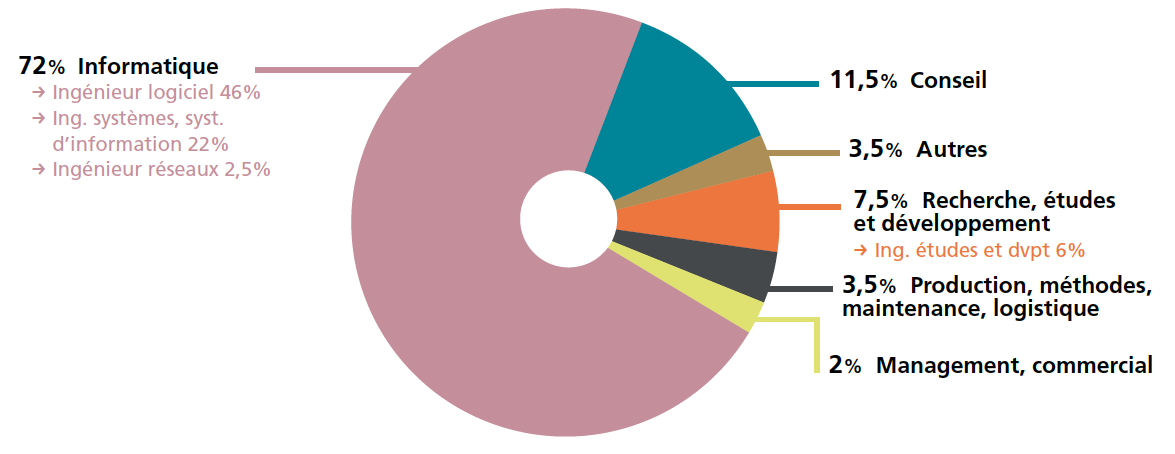
Roles Held by Graduates
Student Track and Apprentice Track
Projects
Arts & Multi-Agent Systems – ORGIA
"Orgia" is a play featuring human actors and a hardware and software system capable of projecting virtual animals, creating the illusion that the actors are moving through a virtual world. The animals’ behaviors are calculated by a system that uses the actors’ physiological data as input. This data includes heart rate, inhaled air volume, body temperature, and skin resistivity. Using this data, the system reconstructs each actor’s emotional state and influences the animals’ behaviors.
Soccer Robot Platform
The Computer Science Department participated in robot soccer competitions organized by FIRA (Federation of International Robotsoccer Association). The goal is to design a system capable of autonomously controlling a group of robots in a coordinated manner so that they can execute effective game strategies. The robot platform has also been used for other applications in the arts and transportation sectors.
Eurockéennes
In partnership with Territoire de Musique, which organizes the Eurockéennes festival every year, the Computer Science Department helped develop a virtual reality app that allows the Malsaucy site to be set up in its Eurockéennes configuration year-round. In fact, given the cost of renting the structures, the festival must be set up as quickly as possible. It is therefore essential to plan the entire layout in advance. This model offers several advantages, such as the ability to conduct studies year-round without having to physically assemble the festival’s components, or the ability to modify and validate the layout of these components in preparation for the next festival.
Wi-Fi Radio Communications Network
In the Networks & Telecommunications field, the department is involved in several projects related to radio communication technologies. Among these, the Wi-Fi system currently serves as the basis for three projects in which we are participating.
First, a project on the deployment of a mesh Wi-Fi network in the TECHN’HOM area in Belfort.
Second, a technology transfer project involving a coverage calculation algorithm, in partnership with the company TRINAPS (the attached figure shows a building layout with an antenna and radio coverage).
Finally, a project to study radio coverage within the UTBM in partnership with the CRI (Center for IT Resources).
The diploma
RNCP Number 38958
, valid from September 1, 2023, through August 31, 2028
After my preparatory program, I enrolled in the computer science department’s LEIM track, specializing in software for embedded systems. At UTBM, we dive right into both the theoretical and practical aspects through team-based projects that help us apply what we learn in class—an approach I really appreciated. As someone passionate about languages, I spent a semester studying abroad in Germany through the Erasmus program at Saarland University. This led to me securing a final-year project at the university’s research center. This experience was very enriching, allowing me to deepen my skills in the areas of research and work organization. After graduating, I received three job offers. I chose a position in Austria in my field of specialization. Once I’ve gained solid experience, why not pursue a Ph.D.?
UTBM Graduate – Researcher in Knowledge-Based Vision Systems, SCCH – Austria