
Student Track and Apprentice Track
Home / Training / Engineering Programs / Energy and Electrical Engineering Specialization (Apprenticeship Program)
To design, size, simulate, and implement industrial electrical systems; manage industrial and R&D projects; and conduct tests, measurements, and trials.
The electrical engineering apprenticeship program draws on the state-of-the-art facilities of the UTBM’s Energy Department. The department operates a training and technology transfer platform focused on land transportation and energy. This platform enables apprentices to develop projects aligned with existing and emerging technologies.
It also benefits from the Energy Department’s industrial, academic, and international connections and partnerships. Each year, apprentices complete 600 hours at the school and 1,000 hours at a company, following a progressive work-study schedule. This alternating schedule—between periods of training and on-the-job experience—allows students to combine the acquisition of theoretical knowledge with its application in an industrial setting.
Objectives
Training Organization
During the three-year program, the curriculum focuses on the fields of electrical engineering, power electronics, automation, industrial computing, and electronics. Mathematics, project management, communication, and English are also key components of the program.
The final semester of the program allows students to apply the skills they have acquired through technical projects, just as they would in an engineering firm. Examples of projects undertaken include: an electric go-kart, a hybrid vehicle, and an autonomous robot.
Our Resources
Electromagnetic Compatibility (EMC) Platform
500-square-meter Educational Platform on Energy and Land Transportation
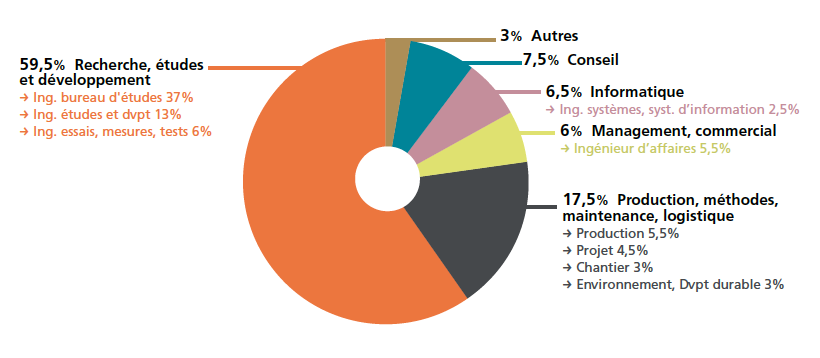
Roles Held by Graduates
Student Track and Apprentice Track
Suprakart Project
Develop and design an electric go-kart
This project involves the design, development, and construction of an electric-powered go-kart. This project was assigned to the first class of engineering students as a group project to be completed during their third year.
The goal is to build a go-kart by applying the skills acquired during the three years of engineering training.
Indeed, while drawing on the knowledge and expertise gained, students will need to demonstrate initiative, independence, and commitment to achieve the best results.
To carry out this project, the apprentice group divided itself into various design teams. Each student joined the team of their choice based on their professional experience and skills.
This is how the TESLA class organized itself into five teams to develop the electric go-kart. Each team is responsible not only for designing its own component but also for monitoring progress, organization, scheduling, and coordination among the various design teams.
This joint project fits perfectly within the framework of engineering education through apprenticeships. It is designed to enable each participant to showcase and develop their technical, organizational, and managerial skills as part of a complex engineering project.
Technical Specifications
Expected Performance
The diploma
Valid from September 1, 2023, through August 31, 2028
My field is electrical engineering and everything related to it. I already knew this by the end of high school when it came time to choose my future course of study. UTBM appealed to me because of its comprehensive electrical engineering program, its international focus, and the opportunity to complete the program through an apprenticeship. So I enrolled at UTBM in September 2010, beginning my engineering program with a core curriculum and focusing my course selections on the field of electrical engineering. During those first two years of study, I was fortunate enough to spend an Erasmus semester in Riga, Latvia. It was an extraordinary experience that enriched me both culturally and personally. As the core curriculum drew to a close, I became even more certain of my desire to continue my education through an apprenticeship, and in 2012 I had the opportunity to join EDF’s teams at the construction site of the new-generation EPR nuclear power plant in Flamanville. During those three years of work-study, I took on numerous responsibilities and actively participated in resolving on-site issues and implementing design changes on this major project. The apprenticeship allowed me to be part of a large-scale project and tackle real-world challenges, and for me, it’s the best way to learn the engineering profession—through hands-on training immersed in an industrial environment.