The Humanities Division occupies a unique position due to its interdisciplinary nature within engineering education. It is also distinguished by its technological research in the humanities and social sciences, conducted within the interdisciplinary FEMTO-ST/RECITS research cluster.
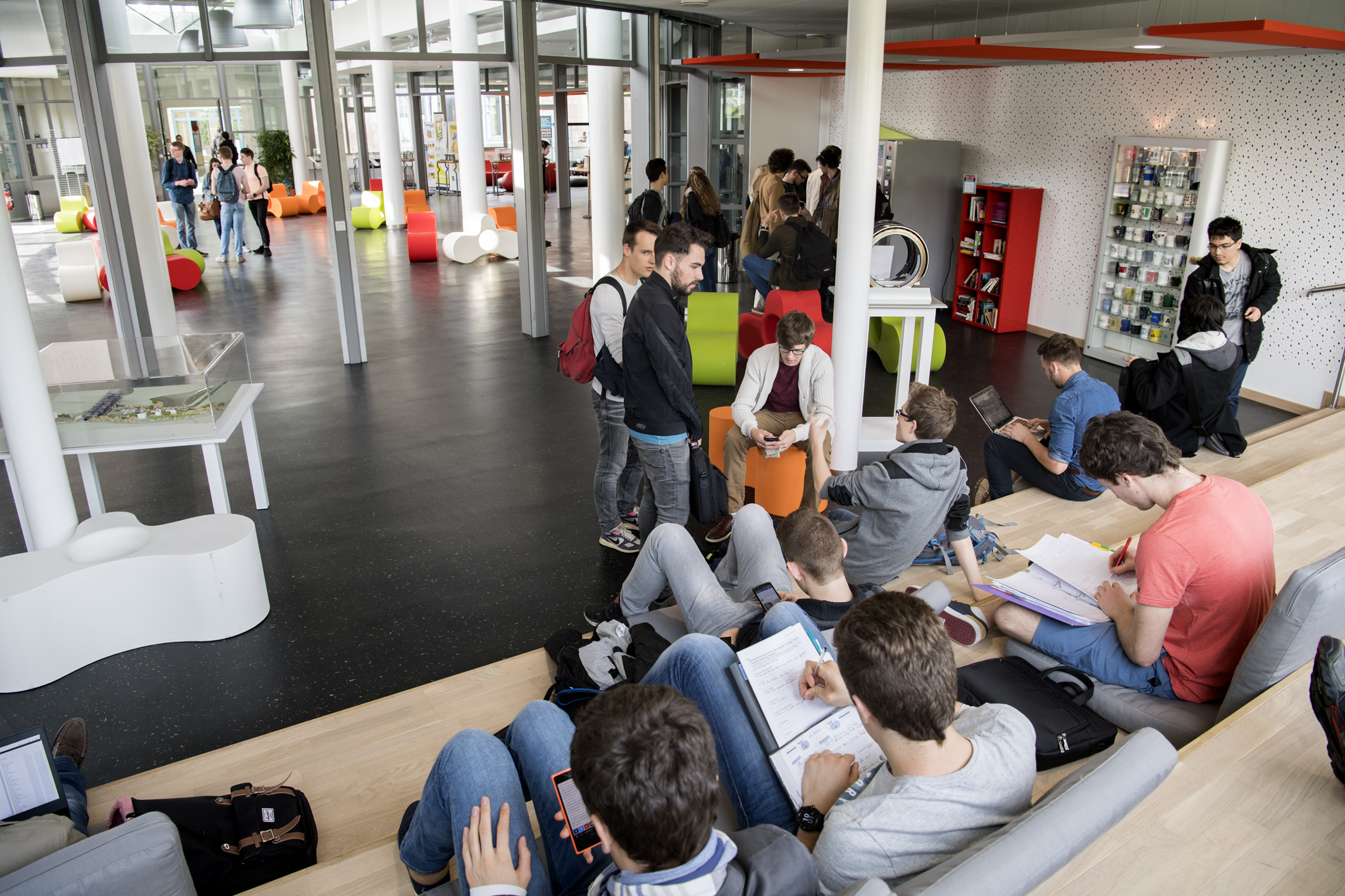
Throughout the program, courses in the humanities help shape engineers with humanistic values—open to the world, attentive to people and the environment, capable of giving meaning to technology while maintaining a high level of professionalism and feeling completely at ease in the business world. UTBM produces engineers who are both philosophers and technologists, combining engineering knowledge with humanities perspectives on technology.
The Humanities division provides significant exposure to the humanities and social sciences, accounting for 25 percent of the coursework offered over the five-year engineering program.
Building on a collectively developed strategy, the Humanities Division aims to address several challenges through its teaching, research, and the dissemination of knowledge.
Strengthening Multidisciplinarity and Interdisciplinarity in the Social Sciences and Humanities (SSH) / Social Sciences and Humanities (SSH) and Political Science and International Relations (SPI)
Strengthen ties with socioeconomic and institutional circles
Committing to sustainable development and an ecological and societal transition
Strengthening Technological Research in the Social Sciences and Humanities
Strengthen international partnerships
Enhancing quality of life at work and the division's culture
The Humanities Division provides engineering students with communication skills (written and oral expression), methodological tools, and a solid general education in fields as diverse as sociology, history, management, administration, philosophy, cultural heritage, art, law, languages, and economics, as well as practical and athletic training.
From an educational perspective, the Humanities division encompasses two main categories of courses:
These courses are organized intofiveskill-building tracks, each consisting of a number of course units that students can choose freely (see the Humanities Division’s welcome booklet for details).
For students enrolledin a5-year UTBM program, enrollment in the T2S tracks begins in the second year.
Requirements for Obtaining a T2S Path
To have your coursework recognized upon completion of the program, please follow the procedure available at the following link: Procedure Guide for T2S Coursework Validation.
It includes administrative information (a registration form to be completed), academic information (a statement of purpose to be submitted), and the requirements for completing the chosen program.
International Career Paths
Manager:Nathalie Kroichvili
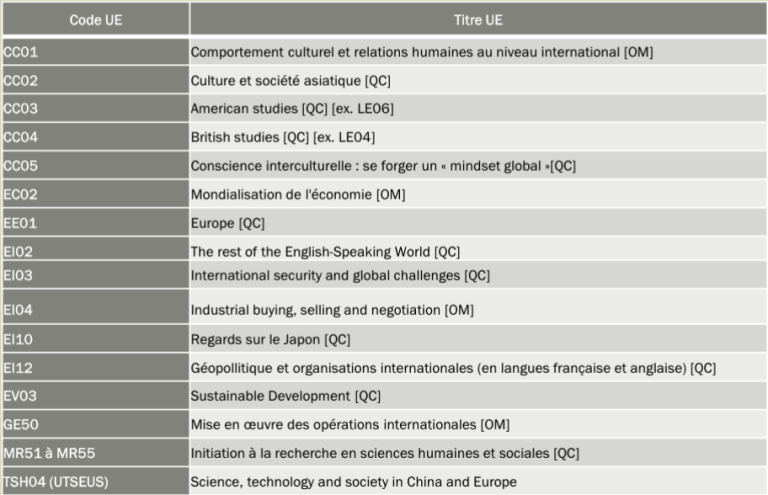
The goal of this program is to raise your awareness of international issues (economic, geopolitical, and societal) and to help you develop an international perspective—one that will be valuable for your career as an engineer, whether in France or abroad, as well as for your life as a citizen. A substantial portion of the coursework is taught in English.
Key Topics:
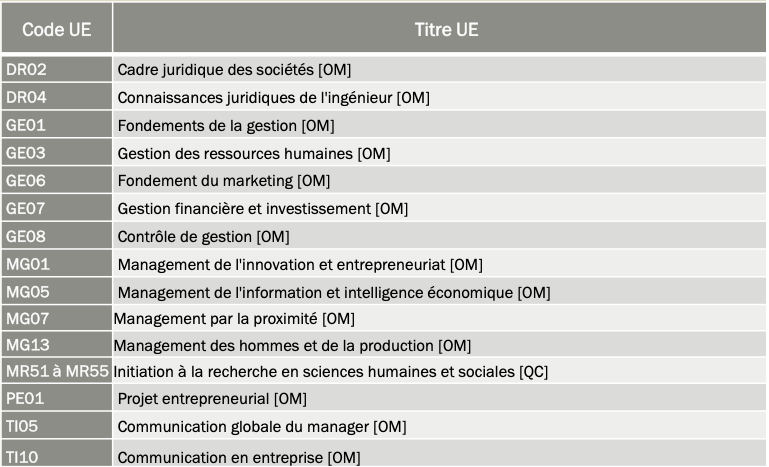
Entrepreneurship and Management Track
Manager:Christian Girardot
The managerial role is now essential to any engineer’s work, as engineers must manage—beyond the technical aspects of a project—issues related to team management, finance, marketing, and law. Throughout their career, engineers may also be called upon to develop new business ventures, either within an existing company or by starting their own business. Upon completing this program, you will be able to manage the managerial and entrepreneurial aspects of a project in collaboration with the finance, marketing, and legal departments. You will also be able to critically evaluate a company’s strategic decisions.
Key Topics:
Technology, Environment, and Sustainability Track
Manager:Mathieu Triclot
The goal of this course is to encourage you to engage in an in-depth reflection on the social role of engineers and their position within organizations in the context of climate change and the Anthropocene. This program offers multiple perspectives on the ethical and political challenges of the engineering profession, combining concrete analysis of workplace situations with historical and philosophical reflection on the process of innovation and technological change. It also enables you to examine issues related to corporate social responsibility and the challenges of the ecological transition.
Key Topics:
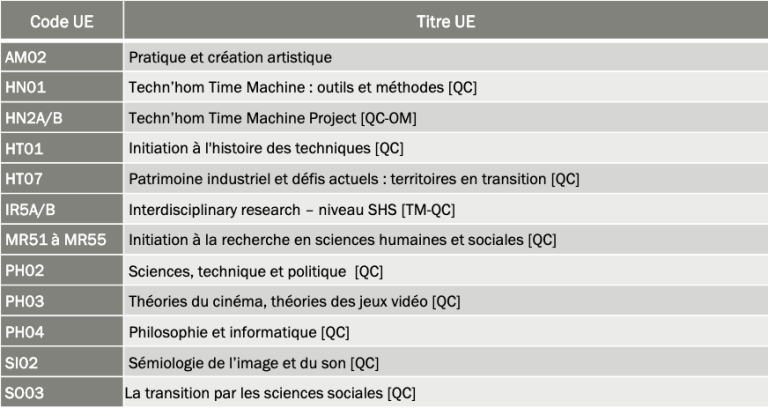
Innovation and Technological Change Journey
Manager:Mariyana Amova
The goal of this track is to introduce you to contemporary issues in innovation. These issues are addressed by focusing on the non-technological aspects of innovation. The focus is on analyzing the economic, managerial, historical, and legal dimensions of innovation processes. By the end of this program, you will be able to play an active role in creating value, propose innovative solutions within the company by taking into account the constraints and opportunities of your environment, and facilitate dialogue within the company and among project teams involving various business stakeholders.
Key Topics:
Digital Humanities Track
Manager:Marina Gasnier
The “Digital Humanities” track offers a series of courses designed to help students integrate the theoretical
, and methods drawn from the humanities and social sciences, statistics, and computer science (CAD, databases, quantitative methods, etc.).
Through its courses, this track explores, more broadly, the digital transformation of society and its consequences for the production and dissemination of knowledge.
As an interdisciplinary program, it demonstrates that combining different tools enriches the subjects of study, allows them to be examined from new perspectives, and even facilitates their analysis and dissemination.
Key Topics:
These courses focus on expression and communication in various foreign languages: German, English, Arabic, Chinese, Korean, Spanish, French as a Foreign Language, Italian, Japanese, and Russian.
Learning Outcomes
The goal of foreign language instruction is to help you succeed in multicultural, globalized, and diverse professional environments:
STUDYS Program for Students with Disabilities
Studys is a tutoring program designed to support students with disabilities, particularly those with learning disabilities such as dyslexia. It is divided into three modules, each consisting of eight activities. These modules correspond to the core course units LE01, LE02, and LE03.
A Tiered Structure
Foreign languages are taught by proficiency level:
Enrollment in a foreign language course requires that you take a placement test upon entering UTBM if you have studied that language before, or that you successfully complete the course at a level lower than the one you are aiming for.
An English language support program for students who are struggling
Students nearing the end of their program who have not yet achieved the B2 level or who are struggling with English will be directed to “UE LE50 – Succeeding on the Linguaskill: Support and Remediation,” which allows them to become familiar with the exam format, practice with sample exercises, take practice tests, and take the Linguaskill exam at the end of the semester.
UTBM prepares you to take several international language exams as part of courses Lx03 and Lx08. When you take a Level 03 course, you are automatically registered for the corresponding international exam:
If you have a high level of proficiency in English, German, or Spanish (e.g., children of expatriates, parents from two different cultures, etc.) without having taken an international exam, you may, if you wish, be authorized to enroll in post-Lx03 course units. Please contact the UTBM language program coordinator, who will grant you a waiver for this purpose and advise you on the best way to take the corresponding international exam.
Registration for an international exam: English, German, Spanish, French
You will be asked to pay a portion of the registration fees for international exams during the semester in which you take the exam. Regardless of the exam, this contribution is based on the Linguaskill Business rate and is the same amount; the difference for the ZD, DELE, and TCF is covered by UTBM. The fee charged is lower than typical external rates (e.g., at Chambers of Commerce and Industry, language centers, etc.). Additionally, UTBM provides its facilities free of charge for exam proctoring.
Preparation for the International English Exam
Certification of a B2 level in English is a prerequisite for obtaining an engineering degree, in accordance with the recommendations of the Commission des Titres d’Ingénieur: http://fond-documentaire.cti-commission.fr/fr/fond_documentaire/document/10/chapitre-element/478 (a score of 160 on the Linguaskill Business, 785 on the TOEIC, 60 on the BULATS, 567 on the TOEFL, CLES Level 2, etc.). UTBM prepares you for the Linguaskill Business exam. However, passing any other academically recognized international exam is also fully acceptable.
Preparation for the international English exam is part of the UE LE03 course.
If, upon your arrival at UTBM, your English proficiency has already been certified by an international exam at a level equal to or higher than B2 (namely B2, C1, or C2), then you are not eligible to enroll in LE03.
If, upon your arrival at UTBM, you are placed at a post-LE03 level but do not have a B2-level certification, you are not authorized to enroll in LE03. However, you will be able to take the Linguaskill Business test and will be contacted in due course regarding this.
To the extent possible, if you fail the international English exam but pass UE LE03, you will be given priority for enrollment in a post-LE03 UE.
However, we would like to emphasize the importance of regular personal practice to help you develop your skills as soon as you arrive at UTBM, and we strongly encourage you to undertake one or more voluntary, personal study abroad experiences. We also strongly recommend that you enroll in UE LE03 as soon as your language proficiency allows, so that you can prepare for the Linguaskill Business exam under the best possible conditions.
Preparation for the International German and Spanish Exams
Upon your arrival at UTBM, if you have already passed one of the aforementioned international exams in German and/or Spanish (DELE, ZD), you do not need to retake it (them). However, you may retake these exams, but you are not permitted to enroll in LG03 and/or LS03.
Registration for the international exam occurs automatically upon enrollment in LG03 and/or LS03.
In exceptional cases, registration for the international exam may be separated from registration for LG03 and/or LS03 in your best interest and at the express request of the course coordinator (to be postponed by one or two semesters, for example, due to a level that is too low, which would make it advisable to take post-LX03 course units early).
If you fail the UTBM LG03 and/or LS03 course units and pass the corresponding international exam during the same semester, later in your studies, or on your own, you will be able to register for post-LG03/LS03 course units.
An absence from the international exam (except in cases of absence from exams as provided for in the academic regulations) will result in the loss of the partial cost coverage provided by the UTBM (see below).
If you do not pass the German or Spanish proficiency exam on your first attempt, you will be fully responsible for the cost of your second registration.
Partial financial assistance for the German and/or Spanish exam is available if you are enrolled in a Master’s program. However, this assistance does not apply if you are enrolled in a doctoral program at UTBM.
Passing an international exam in German and/or Spanish (or any other language) does not exempt you from obtaining a B2 level in English.
Preparation for the International Chinese, Korean, or Japanese Exam
Preparation for these exams takes place in the following course units: LC08 for the HSK, LK08 for the TOPIK, and LJ08 for the JLPT.
It allows you to work toward earning an internationally recognized certification, in consultation with the instructors of these languages.
Success in these course units is contingent upon passing the corresponding exam.
While these three exams—which truly add value to any engineer’s resume—are not eligible for any specific financial assistance from UTBM, their cost is relatively low.
Preparation for the International French Exam for International Students
If you are an international student, certification of a B2 level in French (in addition to a B2 level in English) is a requirement for obtaining an engineering degree, in accordance with the recommendations of the Commission des Titres d’Ingénieur.
UTBM prepares you for the TCF Tout Public. That said, passing any other academically recognized international exam (such as the DELF or TEF) is also fully acceptable.
Preparation for the international English exam takes place as part of the UE LF74 program.
Research in the Humanities division is conducted within RECITS (Research and Studies on Industrial, Technological, and Societal Change), a cross-disciplinary program in the humanities and social sciences at the FEMTO-ST Institute, which is overseen by UTBM along with other higher education and research institutions (UFC, ENSMM) and the CNRS.
The FEMTO-ST Institute is a joint research unit (UMR) with 750 members that primarily conducts basic and applied research in the scientific fields of engineering, with a unique focus on fostering interdisciplinary collaboration between engineering sciences and technologies and the humanities and social sciences as they relate to technology.
RECITS’ research activities thus focus on the analysis of technological change as well as organizational, societal, and territorial change. Rooted in their disciplinary communities (history, epistemology, and the history of science and technology; economics; sociology; philosophy; and regional studies), RECITS researchers contribute to the development of original technological research based on a dual interdisciplinary approach: both within the humanities and social sciences and between engineering sciences and technologies and the humanities and social sciences.
This type of technological research is also fueled by the involvement of RECITS researchers in the GIS-UTSH, which is dedicated to promoting teaching and research in the humanities and social sciences within technical settings.
Finally, at the local level, RECITS maintains strong institutional and scientific ties with higher education and research institutions such as CRESAT (UHA), the institutions and research institutes that are members of the Franco-Swiss “Communauté du savoir” network, as well as MSHE Ledoux (Besançon) and USR FCLab (Belfort).