Home / Publications / Educational and Humanities Collection
The collection reflects research conducted in the field of technology education and/or the humanities. The collection includes publications that document this research (reworked dissertations, conference proceedings, etc.) and its practical applications (experiment reports, teaching materials, and student projects). It demonstrates our university’s strong commitment to disseminating the innovative initiatives taking shape within its walls.
The Researcher in Action
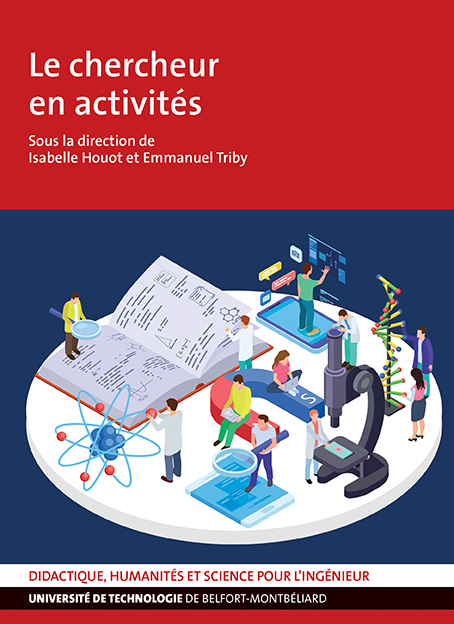
Edited by Isabelle Huot and Emmanuel Triby
Publication Date:December 2020
. Dimensions: 16x 22 cm / 264 pages
Paperback:18 euros – ISBN 979-10-91901-41-3
PDF:14 euros – ISBN 979-10-91901-42-0
Bundle (paperback + PDF):20 euros – ISBN 979-10-91901-43-7
Content:The analysis of activity is now at the heart of research in the humanities and social sciences. Yet few studies focus on the research activity itself—not the research process, not the profession or its characteristics, but the activity, just like any other human activity; a specific activity, however, one that is complex and variable, and one that differs across research fields and time periods. A team from the Interuniversity Laboratory for Education and Communication Sciences (LISEC) now presents an exploratory study on various aspects that make up the researcher’s activity.
Echoing the findings of national and international studies on this topic, the first part presents a series of surveys—both quantitative and qualitative—that examine the sociodemographic and institutional characteristics of researchers’ work and their career paths, as well as the representations and conceptions that researchers themselves develop about their work.
The second part attempts to capture the actual work that researchers perform based on the requirements and constraints that shape their activities. The researcher’s commitment thus finds its meaning in the skills employed, the decisive role of the written word in this activity—from documentation to publication—as well as in the execution of their teaching duties.
In the third part, various forms of researcher engagement emerge as interactions that influence both research methods and practices, as well as research outcomes. The irreducible element of subjectivity in research takes on different forms, each representing a way of placing oneself at the heart of the research once again.
Authors: Vanessa Boléguin, Louis Durrive, Mélodie Faury, Stéphane Guillon, Isabelle Houot, Sophie Kennel, Nathalie Lavielle-Gutnik, Hugues Lenoir, Charlyne Millet, David Oget, Magali Roux, Mary Schirrer, Daniel Schmitt, Michel Sonntag, Emmanuel Triby
Using History to Teach Science!
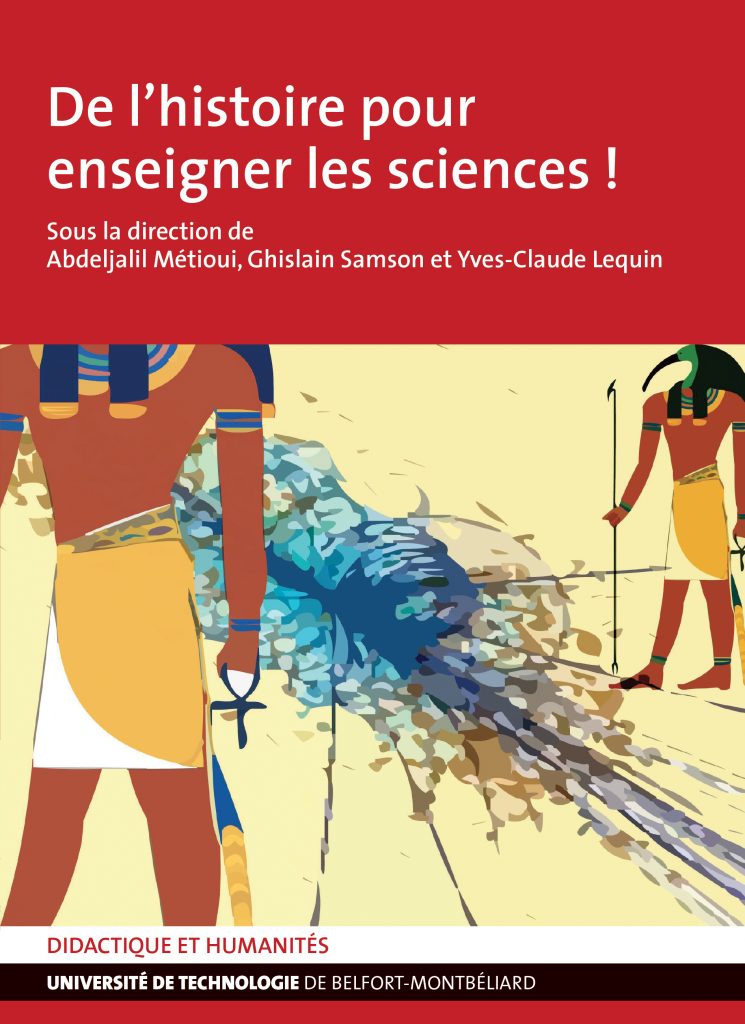
Edited by Abdeljalil Métioui, Ghislain Samson, and Yves-Claude Lequin
Publication date: March2013
. Dimensions:16 x 22 cm / 208 pages
Paperback:18 euros – ISBN 978-2-914279-70-3
PDF:13 euros – ISBN 978-2-914279-71-0
Bundle (paperback + PDF):20 euros – ISBN 978-2-914279-73-4
Content: Thisbook is intended for anyone (teachers, educational researchers, trainers, parents, etc.) interested in the conditions under which science has developed throughout history, and in how these can be leveraged to foster a better understanding among students.
Ten chapters first outline several key aspects of the history of science, before exploring the origins of certain concepts in chemistry, biology, physics, and mathematics, and suggesting approaches to facilitate such learning. The authors suggest a teaching approach that will encourage young people to reflect on the conditions—political, economic, and social—under which science advances. They also highlight epistemological and philosophical considerations. Such reflection leads them to view science as a human activity and to draw parallels between students’ current conceptions and those developed throughout history. This historical approach will also enable educators to put their students’ errors into perspective—or even to use them to their advantage—by viewing them as indicators of a challenge that requires the development of teaching strategies that go beyond the purely logical and mathematical aspects of science.
Authors: Jocelyn R. Beausoleil, Michel Bélanger, Félix Bouvier, Alain Essaddam, David Guillemette, Corneille Kazadi, Yves-Claude Lequin, Fathi Matoussi, Simone Mazauric, Abdeljalil Métioui, Donatille Mujawamariya, Lucie Ouimet, Ghislain Samson, Louis Trudel
Education and the Olympic Movement in Europe
Edited by Eric Monnin, Jean-François Loudcher, and Gilles Ferréol
Publication date: February2012
. Dimensions:16 x 22 cm / 216 pages
Paperback:17 euros – ISBN 978-2-914279-57-4
PDF:14 euros – ISBN 978-2-914279-58-1
Content: Thisbook is the result of the discussions and debates that took place during the Francophone study day on December 3, 2009, titled“The Place and Role of the Olympic Movement in Education in Europe.”
The event, held in Besançon, brought together some fifteen speakers who discussed issues related to the values of the Olympic spirit in schools and other settings, such as museums and recreational activities.
These presentations were supplemented by several additional texts. Most adopted primarily historical, sociological, or philosophical perspectives. The guiding concern behind this contribution is indeed that of a quest—not for the defense of identity, but for openness and critical inquiry—in order to move beyond the overly polarized reactions of rejection or adoration that the Olympic spirit sometimes provokes. Indeed, it seems that for some time now, the concept of Olympic education has once again become an important factor in educational practice, if not in France, then at least in Europe: this is undoubtedly because education calls for the transmission of values, and these values are being questioned in terms of their ability to meet the challenges of the future while ensuring the sustainability of societies.
It is therefore interesting to examine to what extent this form of education is a value worth considering, discussing, or rejecting, and how it might potentially be implemented or promoted.
In any case, it is important to consider the Olympic movement in all its dimensions, as it is a phenomenon that holds significance not only for young people, educators, and researchers, but also for policymakers and civil society, given its prominence in both the media and culture.
Authors: Michaël Attali, Anne Chevalley, Renaud David, Bertrand During, Gilles Ferréol, Konstantinos Georgiadis, Jean-François Loudcher, Régis Malige, Éric Monnin, Jacques Rogge, Jean Saint-Martin, Otto Schantz, Pedro Velazquez Hernandez, Patrick Vassort, Stephan Wassong
English: Technology-Based Mediation
By Paul Arthaud
Publication date:January 2010
; Format: 16x 22 cm / 272 pages
Paperback:18 euros – ISBN 978-2-914279-43-7
Audience:Language teachers; trainers; trainees
Content:This book is intended for all language teachers; it demonstrates that the use of computers, multimedia, and the Internet in the teaching and learning of a modern language cannot take place without constant reflection and analysis based on the theoretical data provided by academic research (in language pedagogy, linguistics, and cognitive science, among other fields).
Using a concrete example—the creation and use of digital educational microtasks for English—the author illustrates the practical steps involved.
Under such conditions, information and communication technologies play a revealing role: they bring to light previously unsuspected problems and unveil new ways of working in which the teacher becomes a mediator, guiding the learner. Promising new avenues are opening up that draw upon new knowledge, skills, and attitudes.
Author:Paul Arthaud
Book Review: *LesLangues Modernes* 2/2010: “Artistic Practices and Linguistic Practices: What Synergy?”