Since 1987, UTBM, through its LERMPS (ICB) laboratory, has been internationally recognized for its work on surface treatments. As a pioneer in the field, it has also been developing a complementary metal additive manufacturing business for the past 20 years.
To strengthen its research efforts, UTBM has recently acquired an SLM (Selective Laser Melting) additive manufacturing machine equipped with a “green” laser (with a wavelength of 515 nm).
Representing a total investment of 404 k€, and having received support from the Bourgogne-Franche-Comté region, this new process is unique in France. It thus complements a fleet of SLM metal additive manufacturing machines, alongside other processes.
This is, in fact, the first system of its kind acquired in France (another is currently being operated on a rental basis in the Paris region). To date, there are only seven such systems in the world.
Particularly well-suited for alloys that absorb little laser radiation—such as copper, for example—this equipment uses the specific wavelength of its high-power laser to fuse these materials and thus produce parts. In fact, copper absorbs approximately three times more energy from the “green” laser at a wavelength of 515 nm used in this equipment, compared to the infrared lasers at 1060 nm that are commonly used. This results in significantly better metallurgical quality, among other benefits.
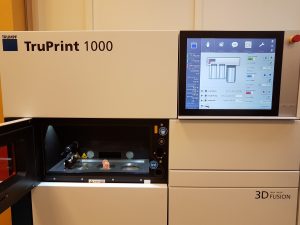
This equipment enhances the UTBM’s capabilities for 3D printing of copper and copper alloy components, which have been the focus of research by its teams for several years (development of specific alloys, process development, metallurgical studies, characterization of the properties of the resulting materials, etc.). It thus complements the range of (micro)fabrication resources available through the MIFHySTO platform, particularly for shaping watchmaking alloys.
The intended applications are numerous: heat sinks, electromagnets, inductors, electronic and watchmaking components, luxury goods, etc.
As a first example, it took more than 20 years of work to develop an innovative additive manufacturing process—based on thermal spraying—that enables the production of rocket engine combustion chambers (for the Ariane rocket, in particular). In the future, this process will reduce the time required to manufacture a combustion chamber from 6 months today to just a few days, while using fewer strategic materials and improving the chambers’ performance.
As another example, several years of research have led to the development of inductors capable of generating very strong magnetic fields. These developments were directly applied at UTBM to design the system components that made it possible to generate one of the strongest continuous artificial magnetic fields ever created in the world (37 Tesla in a 37-mm-diameter cavity) at the LNCMI-CNRS laboratory in Grenoble.
The new equipment, now in operation, will make it possible to produce parts with more complex geometries than were previously possible. It supports research efforts—both in-house and in collaboration with industrial partners—and will quickly become an integral part of the various specialized courses offered at UTBM.
We and our researchers are available to welcome you to our facility on the UTBM campus in Sevenans (90) to explore this state-of-the-art equipment and its applications.