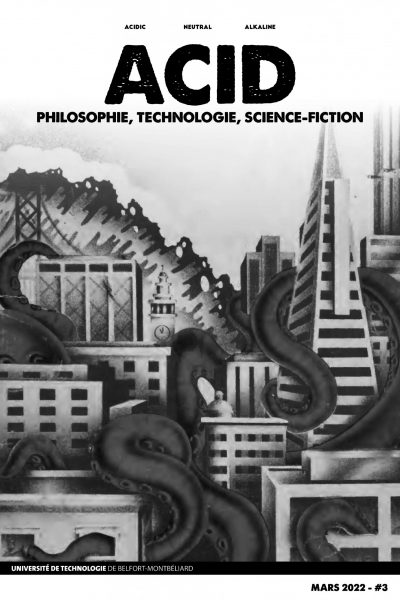
Now available online¹, this issue was written entirely by students in UTBM’s PH02 course—science, technology, and politics—and PH04 course—philosophy and computer science. What’s new this year is that the issue is considerably more substantial, featuring some thirty articles!
Hence the need to rethink the issue’s central theme, organizing it around a set of thematic groupings
, while seeking to interweave articles that deal with fiction—drawing on the method for visualizing character networks developed by mathematician Yannick Rochat2—with articles that analyze the social effects of computer science. At the heart of this issue, the exploration of dystopias, the metaverse, and the portrayal of computer scientists in pop culture invites us to navigate between reality and fiction: Can fiction teach us anything about reality? Does it help shape it? Can we draw on them to reignite our technological imagination?
On the topic of the social impacts of computer science, students this semester took a particular interest in the successes and limitations of deep learning, focusing notably on AI-generated art and deepfakes, as well as the promise of automating the programming process! Added to this are current issues such as El Salvador’s adoption of Bitcoin, the effects of network structure on the dissemination of information, and the expected impacts of quantum computing.
On the science fiction front, three themes emerge from the selection of works. The division into two opposing worlds—based on a hierarchy between the lower and upper realms—is a major motif that unites many sci-fi narratives. These stories center the action on characters who move between these two spaces. By grouping several works together, we can explore the variations within this overarching structure.
A second group of works brings us back to the question of bodily transformations and the more traditional theme of the monster… with an interesting twist: between the poles of the monstrous and the extraordinary body of the superhero, can we envision forms of symbiosis—a cooperation between humanity and its “others,” whether aliens, AI, or animals?
A final group of articles explores the topic of video games and their ethical and political interpretations. Video games invite us to reinvent the method by which networks of characters are created and lead us to genuine research questions: How can stories be told in video games? How are narrative structures transformed by interactive storytelling?
As with every issue, the cover pays homage to the tradition of fanzines chronicling the history of socially engaged computer scientists and engineers—
, People’s Computer Company, New Alchemists—with an image borrowed from the cover of the anarchist hacker magazine *Processed World*³.
Mathieu TRICLO